Code of the day · 2026-10-25
Sunday · 14 Cheshvan 5787
Every day of the Hebrew calendar has a number: the letters of the date add up. Today it is 378. Below: where it comes from, which Torah verse it opens, and what it has to do with your name.
Where this number comes from
Today is 14 Cheshvan 5787. In Hebrew the date is written in letters: י״ד חשון. Every Hebrew letter has a value: א = 1, ב = 2 … י = 10, כ = 20 … ק = 100 … ת = 400. Add up the letters of the date:
14 + 364 = 378
The year is left out, so this same day gives the same number every year, like a birthday.
- Number of the day378
- Page of the Chumash24 / 354
- Verse of the dayBereshit (Genesis) 17:15
In the 861 layout the Chumash has 354 pages, the number of days in a lunar year. If the number is above 354, subtract 354: 378 − 354 = 24.
One number for everyone: on the site, in the bot and on the image. It is a calendar, not a forecast and not a description of anyone. Your own number comes from your name, below.
וַיֹּאמֶר אֱלֹהִים אֶל־אַבְרָהָם שָׂרַי אִשְׁתְּךָ לֹא־תִקְרָא אֶת־שְׁמָהּ שָׂרָי כִּי שָׂרָה שְׁמָהּ
«And G-d said unto Abraham: 'As for Sarai thy wife, thou shalt not call her name Sarai, but Sarah shall her name be.»
Bereshit (Genesis) 17:15 · page 24 of 354
This is from the portion “Lech Lecha” (Genesis 12–17). What it is about: “Go forth”: Abraham leaves Haran; the promise of land and offspring; the covenant between the pieces; circumcision.
Nobody picked it: the letters of today's date add up to 378, and that is page 24 of the 354 pages of the Torah — the Five Books of Moses.
The same number was already written down around 1573: חשמל = מלבוש
In the database it appears 37 times across 19 books. We do not claim this proves anything: we show who wrote it and when, and we recounted it ourselves.
Today is the name's day of: Apolinar, Arusyak, Ashkenaz, Socorro. And your name?
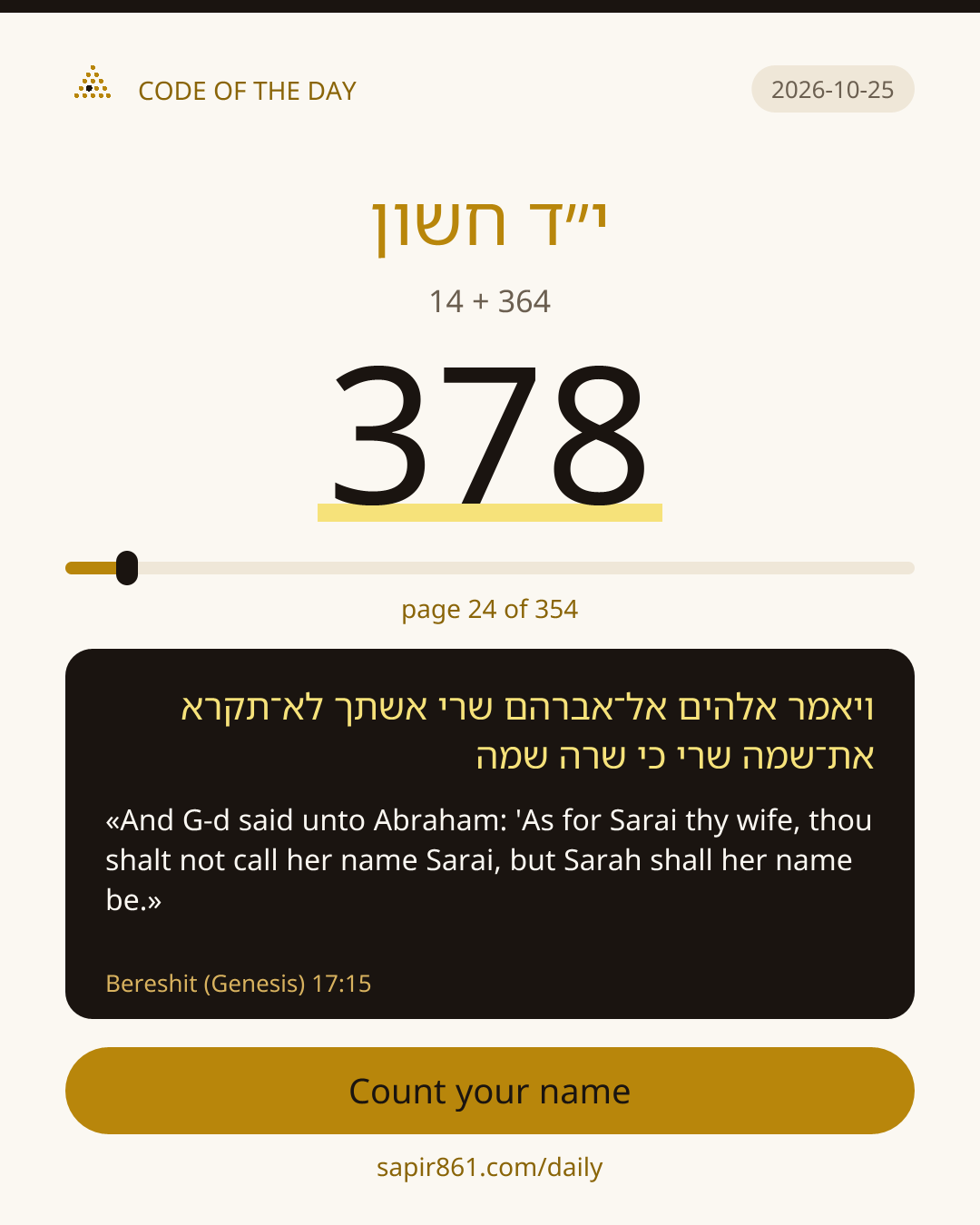
The image is built on the server: date, number, verse and page are the same as on this page.
More about today
Person of the day: three names with one small number
Person of the day
Three names from three eras sharing one small number
A prophet who argued with Heaven about justice: why does the wicked swallow one more righteous than himself? He waited for the answer standing at his watchpost.
A rabbi and doctor of philosophy who taught in New York. He wrote of the person who at once masters the world and seeks meaning in it.
She hid two years in an Amsterdam annex and kept a diary. It has been translated into more than seventy languages.
Why they are side by side
Only the number puts them side by side. That is arithmetic, not an explanation: we checked — equal sums do not imply a shared meaning.
How the small number is obtained: the digits are added until one remains. This is mispar katan, one of the nine classical counting methods; every number has one. Non-Hebrew names are written in Hebrew letters by ordinary transliteration; variants exist, and the number depends on the spelling. We show the letters so it can be checked. This is a coincidence of counting, not a statement about a person or about the day.
This week's portion, its word and name
This week's portion
Vayera וירא
This Hebrew date across 301 years
A Torah word with this number
This happens more often than the meeting does: measured, the number of the week and the number of the date meet on roughly one day in three. Saying so plainly is the method.
A name from this week's portion
This figure acts in the portion read this week. Their number is shown alongside — with no claim that it matches anything.
Remembered today and the Psalms
Psalms of the day
Under the customary division of the book of Psalms across the thirty days of the month, today's reading is 72-76.
Text: Open Scriptures Hebrew Bible, CC BY 4.0. The four-letter Name is not printed in our output and is replaced by ה׳.
More
- The number 378 in full
- Calculator, 25 methods
- Method and figures
- This date across 301 years
- Your own birth code
Text and morphology: Open Scriptures Hebrew Bible, CC BY 4.0. Calendar: the fixed Hebrew calendar by its own rules. Portion boundaries: the standard annual cycle. Memorial dates follow tradition or the sources noted with each entry.