Number coincidence detector
Number coincidence detector
People post: “name = 33 = date — it’s a sign.” Paste such a claim: the detector runs every common cipher and tells you how often a match like this turns up by pure chance.
Examples: Jesus = 74New York = 9/11/2001America = 50משיח = נחשCoronavirus = 666
Chance of it happening at random
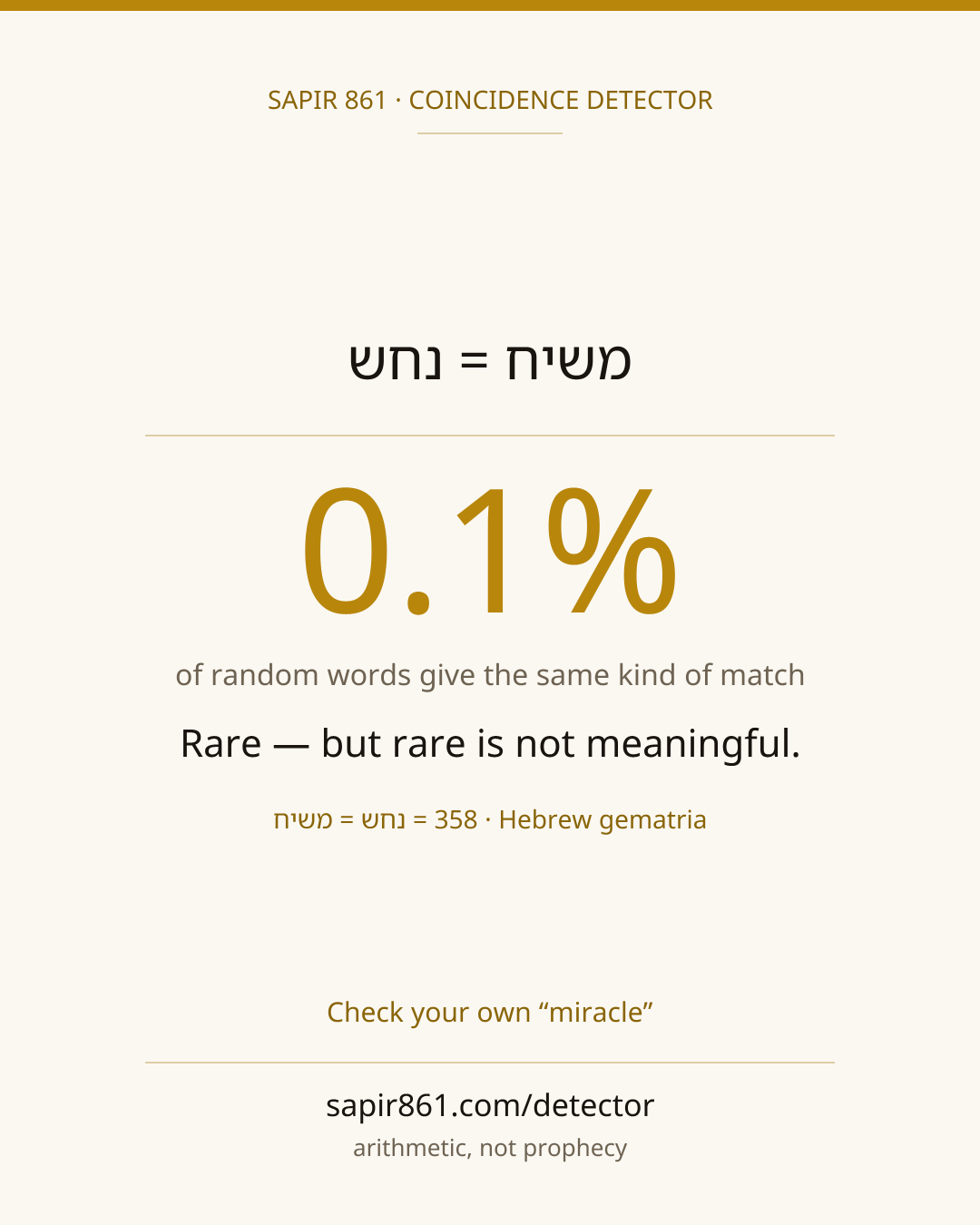
A rare match. But rare is not meaningful: check whether the cipher and the number were chosen after the event.
Replacing “משיח” at random gives at least one match in 0.1 of 100 tries.
Random text of the same length hits at least one “special” number in 12 of 100 tries.
Comparisons that were possible: 1. The more there are, the easier a match is to find.
Matches found
- משיח (Hebrew gematria (משיח)) = נחש (Hebrew gematria (נחש)) = 358
What was counted
משיח · text
| Hebrew gematria (משיח) | 358 |
נחש · text
| Hebrew gematria (נחש) | 358 |
Put your own name in place of the name in the claim — it often matches too.
And your name?
Type your name as usual — see it in Hebrew, its number and the Torah word with the same number.
How it works
- A “decoder” usually picks from many ciphers, spellings and “special” numbers — and shows only what matched.
- We count everything that could have been picked, then repeat it with random words and dates.
- If random words match just as often, the match tells you nothing.
- Real gematria is counted in Hebrew letters; “English gematria” is a set of late tables for the Latin alphabet.
Ciphers and date methods are well-known public tables. Method: Monte Carlo, 1,500 random replacements.
Open Scriptures Hebrew Bible (WLC), CC BY 4.0