Number coincidence detector
Number coincidence detector
People post: “name = 33 = date — it’s a sign.” Paste such a claim: the detector runs every common cipher and tells you how often a match like this turns up by pure chance.
Examples: Jesus = 74New York = 9/11/2001America = 50משיח = נחשCoronavirus = 666
Chance of it happening at random
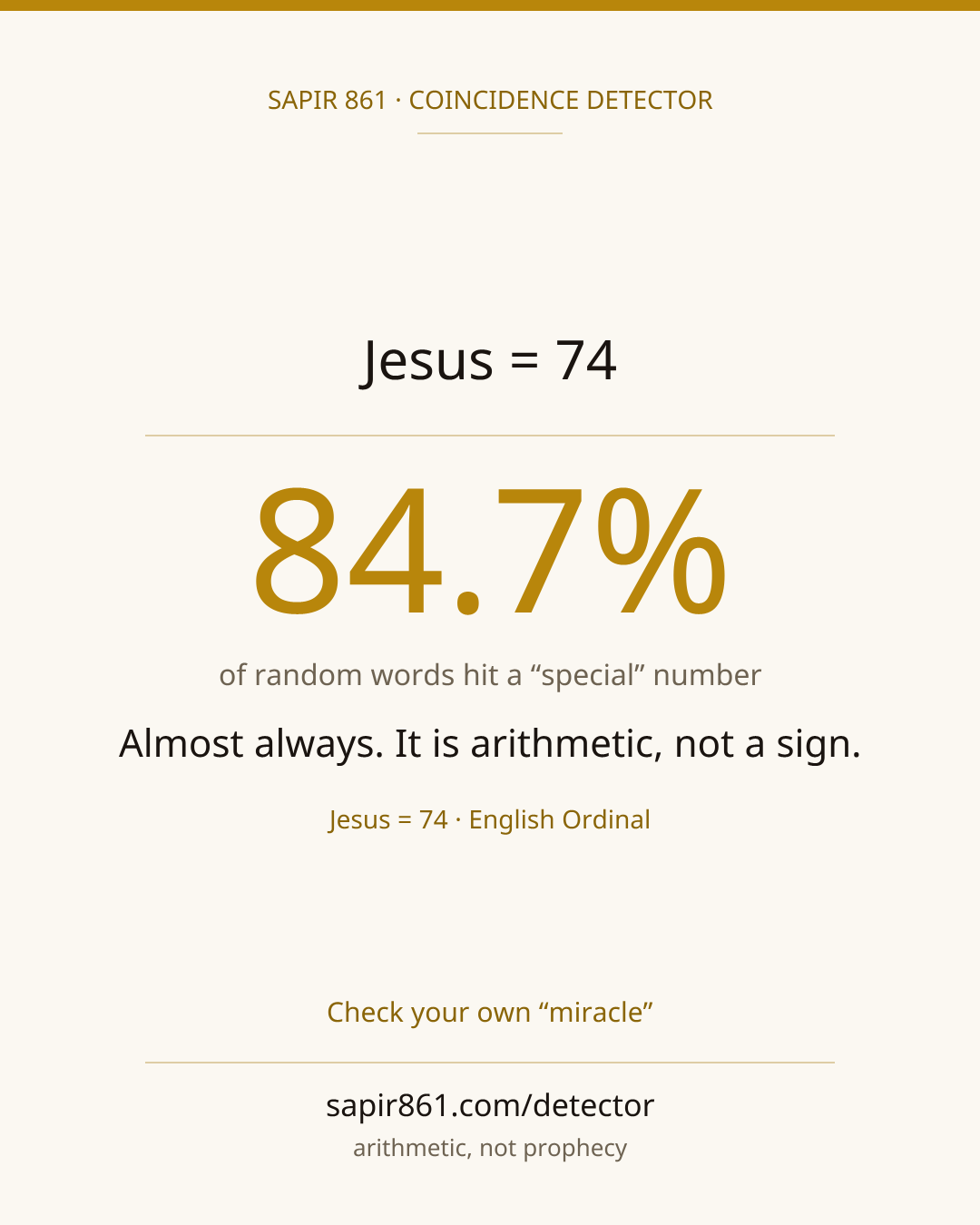
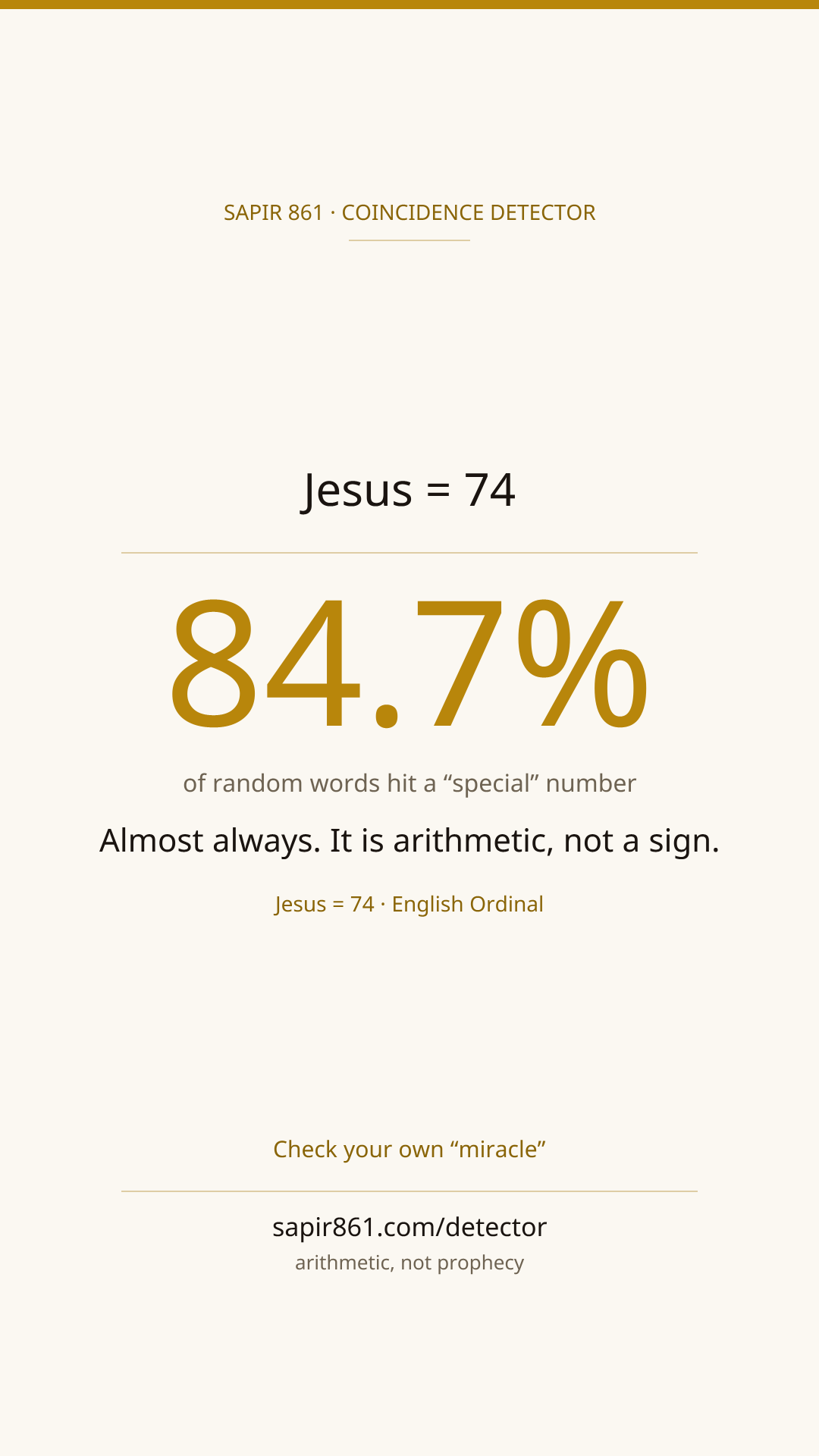
A match like this turns up almost always. It is arithmetic, not a sign.
Random text of the same length hits at least one “special” number in 84.7 of 100 tries.
Comparisons that were possible: 7. The more there are, the easier a match is to find.
Adjusted for searching: counting all 56 options that could be tried here, the chance of finding at least one such match is 100%.
Matches found
- Jesus (English Ordinal) = 74 (number) = 74
“Special” numbers that came up: Jesus → 74 (English Ordinal) · Jesus → 11 (Full Reduction)
What was counted
Jesus · text
| English Ordinal | 74 |
| Full Reduction | 11 |
| Reverse Ordinal | 61 |
| Reverse Reduction | 34 |
| English Sumerian | 444 |
| Jewish (Latin) | 985 |
| Hebrew gematria (ישוע) | 386 |
74 · number
| number | 74 |
Put your own name in place of the name in the claim — it often matches too.
And your name?
Type your name as usual — see it in Hebrew, its number and the Torah word with the same number.
How it works
- A “decoder” usually picks from many ciphers, spellings and “special” numbers — and shows only what matched.
- We count everything that could have been picked, then repeat it with random words and dates.
- If random words match just as often, the match tells you nothing.
- Real gematria is counted in Hebrew letters; “English gematria” is a set of late tables for the Latin alphabet.
Ciphers and date methods are well-known public tables. Method: Monte Carlo, 1,500 random replacements.
Open Scriptures Hebrew Bible (WLC), CC BY 4.0